

crazier
January insanity

Two years on, and the rash has returned, scabbing my elbows’ insides. This isn’t the way things should be. When I had this rash before, I justified it through pseudo-psycho-science: my body was rejecting my surroundings. I must have been in the wrong place with the wrong person; once I left, so did the rash. A holistic influencer’s voice rings through my memory, decreeing, LISTEN TO YOUR BODY. IT IS ALWAYS RIGHT. Your body knows your mind before your mind knows itself. Amen.
What does my body know now, when the leave-this-place rash reappears during a stay in my childhood home? More confusing still, the rash persists back in my L.A. apartment — which, in a grand act of pathetic fallacy, flooded while I was away. I dunked a stocking foot into a puddle of water after a 12-hour travel day and took it as a clear sign to leave.
Leave, like I always say. Leave, and go where?
The new year finds me restive, determined, and inarticulate. I tuck my hands inside opposite sleeves, straitjacketing myself as I scratch the persistent itch. Gracie and I huddle in a corner of the bar, bouncing off the light in each other’s eyes. We crave adventure, we say. We’re willing to get messy again, like when we were younger, but even this means something different to each of us. I mean what I say to her, but when I’m alone again, I see dollar signs and cower. On an unoccupied afternoon, I lie alone in bed because I can do this for free. Itch, scratch, scab.
I read and I watch movies, all about inmates of mental hospitals.
⋇⊶⊰⊱⊷⋇ ⋇⊶⊰⊱⊷⋇
My favorite short story from Gabriel García Márquez’s Strange Pilgrims collection is called “I Only Came to Use the Phone.” María’s car dies, so she hitchhikes to find the nearest telephone (this is the 90s). When the bus drops her off, she asks to use the phone, but they shush her and put her to sleep with the others. The next day, a doctor assesses her. He gives her permission to cry, let it out: “Tears are the best medicine,” he says considerately. She weeps with abandon. She has never let herself weep so freely. The doctor seems sympathetic, but when she asks if she can use the phone now, he tells her, “Not yet, princess.”
It dawns on María that she has been institutionalized.
Back in Barcelona, María’s husband grows jealous and spiteful, believing she has abandoned him, as she had already done once before. When María finally manages to call him, he barks, “Whore!” at the sound of her voice and hangs up. He eventually visits, but not to retrieve her. He, too, accepts that she is too unhinged to rejoin society. María spends the rest of her days in the sanatorium.
I consider María crying to that doctor on her first day. I reminisce on my own famous cries. The time in Berlin I cried so hard Cat gave me half a Xanax and I spent the train ride to Prague drooling and dreaming of cinnamon. That March night in high school when I got out of the car in the driveway and walked away from home, seeing cotton candy in the sky and feeling so hollow in my chest that the cold air never chilled my bare legs. Last fall, when the casting director told me that there was undeniable sorrow in my eyes, which could be my superpower if I learned how to harness it, and all I could do was leak disempowered tears as he rambled on about my potential.
I’ve barely cried in January. I’ve been collected, businesslike, transactional. One Friday, though, I let myself despair as I sat at my desk after hours. I could only shake out two polite tears before the office door swung open and a coworker from a different department declared, “It’s dark in here!” I kept my back to her as she rummaged in a drawer behind me for something she needed. When she left, I couldn’t cry anymore; all my tears had boiled into steam.
I am at my weakest when crying. I become an ugly, inarticulate, blown-up baby crab in the pot; yet the disfiguration is worthwhile, because nothing else teaches me so precisely how far I can feel. Standing on a pier at night, eyes wide open against inscrutable black, consumed by the sound of waves crashing like bones under giants’ teeth. I come close to dropping in completely.
⋇⊶⊰⊱⊷⋇ ⋇⊶⊰⊱⊷⋇
In Mikhail Bulgakov’s The Master and Margarita, the poet Ivan Nikolaevich Homeless is among the first of many Moscow residents who encounter the devil. Ivanushka is promptly shuttled off to a facility with white walls under the tutelage of Professor Stravinsky. Stravinsky hears Ivan out, then tells him, “Your salvation now lies in just one thing — complete peace. And you absolutely must remain here.” With another tranquilizer and some more soothing words, Ivan drifts out of consciousness.
But Ivan did actually meet the devil, who goes by “Woland.” Woland told Ivan an eyewitness account of Pontius Pilate’s behavior on the day he condemned Jesus (here, “Yeshua”) to death. Woland predicted how Ivan’s comrade, Berlioz, would die; moments later, Ivan watched Berlioz die as prescribed. Woland told Ivan that he would have to find out about schizophrenia for himself. Such is Ivan’s diagnosis under Stravinsky.
In the mental hospital, Ivan meets the titular master, who sneaks in through the window late at night to meet his new neighbor. The master believes Ivan about the devil, on account of Pontius Pilate. The master had previously dedicated himself to years of labor on a novel about Pontius Pilate — only for the novel to destroy his reputation and plunge him into a depression so profound that he abdicated his old life to check himself into the hospital. While Ivan is still rebellious, ardent about making sense out of these unjustifiable events, the master is defeated. On some level, the master believes that he is crazy. He accepts his insanity, condemning himself to an insane man’s institutionalized half-life.
But the master is not the arbiter of his own fate. The master’s lover, Margarita, makes a deal with the devil in order to reunite with him. Meanwhile, in realms beyond human intervention, the disciple Matthew Levi appears to Woland to inform him that Yeshua has read the master’s doomed novel about Pontius Pilate. It seems the son of God can better appreciate the story’s spiritual significance than the literati of Stalinist Moscow. Yeshua requests that Woland take the master with him when he leaves the city. Woland wonders why Yeshua doesn’t invite the master into the light with him. Matthew Levi answers, “He does not deserve the light, he deserves peace.”
And so, the master and Margarita are granted a peaceful home in the realm of shadows, there to dwell together forever.
As for Ivan, he leaves the mental hospital one day. He gets a career and a wife, a home and a normal life. Every year, though, on the anniversary of Woland’s visit to Moscow, he becomes sick at heart and cannot handle the springtime full moon.
I think I understand what it means to deserve peace and not the light. When I was in middle school, I was determined to be the best little Catholic in the world in order to be certain I would go to heaven. I prayed everyday. I refused to utter curses, substituting “oh my gosh” for “oh my God.” I went above and beyond, dropping little presents into classmates’ lockers under an alias to spread kindness without seeking appreciation for myself. I considered becoming a nun, willing even to give up my lifelong dream of being chosen, being loved. If such a sacrifice would get me to heaven, it would be the better choice.
Heaven was a beacon. I put my faith in the place the priest described weekly as having “no more tears, no more sadness.” I tried to picture it sometimes, but I couldn’t. Sadness was as natural to me as breath, but I suppose breathing wouldn’t have a place in heaven either. The only image I could conjure was one of a white fountain with everyone sitting placidly around, always smiling.
I wanted heaven to be real because I wanted a place where my father could be healthy again. I wanted my family to have a second chance at being ourselves. A place where my mom, my sister, and myself could be unburdened from all the stalled development our caregiving inflicted upon us. Somewhere we could laugh and smile again, and everything would be unhurried, unworried love. No more tears, no more sadness.
What I really wanted was peace, not the light. I don’t think I am cut out to coexist with a light that blinds.
⋇⊶⊰⊱⊷⋇ ⋇⊶⊰⊱⊷⋇
In the 2002 film Secretary, Lee Holloway is released from a mental hospital on the day of her sister’s wedding. Almost immediately, she relapses into self-harm.
Lee gets a job working as a lawyer’s secretary. Her main qualifications for the position include her ability to type and her natural alignment with the type of woman E. Edward Grey seeks for his secretaries; as Edward’s ex-wife sneers upon first laying eyes on Lee, she is textbook “submissive.”
Edward exerts a power over Lee that is more psychosexual than administrative. He feeds her hot chocolate and tells her to never cut herself again; she promptly drops her girlish box of sharp objects into the stream forever. The following day, after he notices a typo in a letter she transcribed, he makes her bend over his desk to read it out loud while he spanks her repeatedly. She’s really into it.
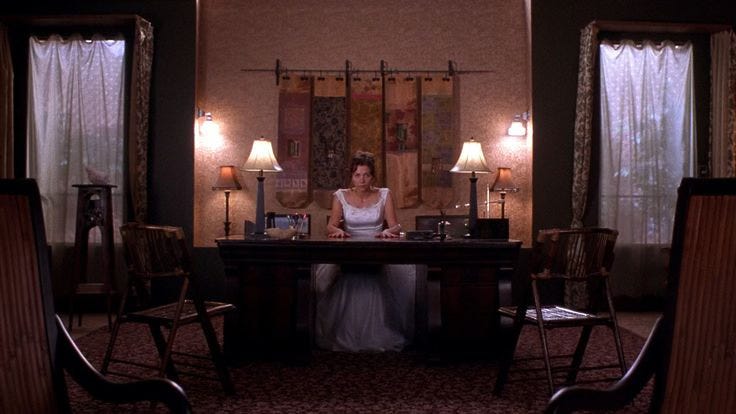
Lee and Edward are awkward and nerdy and pervy. There is little actual sex in the film, yet an abundance of horniness. I, personally, was relieved to see such an unglamorous, campy depiction of two freaks finding love out of lust. I was stirred by the image of Lee Holloway chaining herself to Grey’s desk in a wedding dress. On the verge of collapse from hunger, thirst, and sleep deprivation, under scrutiny from her friends, family, and local news outlets alike, Lee remains determined to prove, once and for all, that she has found her soulmate.
During the 9:45pm screening I attended, there was frequent laughter underscoring close-ups of James Spader’s face as it blanched with desire for his mousy secretary. There were times I laughed along. However, when I walked back to my car afterwards, every snippet of conversation I picked out from among the departing crowd involved nervous laughter and something to the effect of “I don’t know, that was weird.” I grew frustrated.
How hard it is to want anything, much less something specific, something sexual. How tired I am of pretending I don’t desire. I’m sick from laughing at the tragicomic feedback loop. Sure, those reaction shots were kind of funny. Would you still find it funny if it was your yearning face on the screen? Or do you even allow yourself to look at anyone that way? Have you ever?
There is no polite place for animal feelings in a machine world, so these are ridiculed.
This is how we all go crazy.
I have to remind myself every day that my tears and my rage are my most powerful asset. Happy to be human ✌🏻🥴